
As mentioned previously, renting a car to drive around Jeju seems to be the default mode of transport. Many Jeju residents themselves get around by car, because buses take forever to come and taxis are few and far between.
I know it can be quite intimidating (or exciting!) to drive internationally in a foreign land. Whether you’re still on the fence about whether to drive in Jeju, or have set your mind on it and want to know what you’d need to take note of, this guide for driving in Jeju is for you!
Pick a reliable car rental service
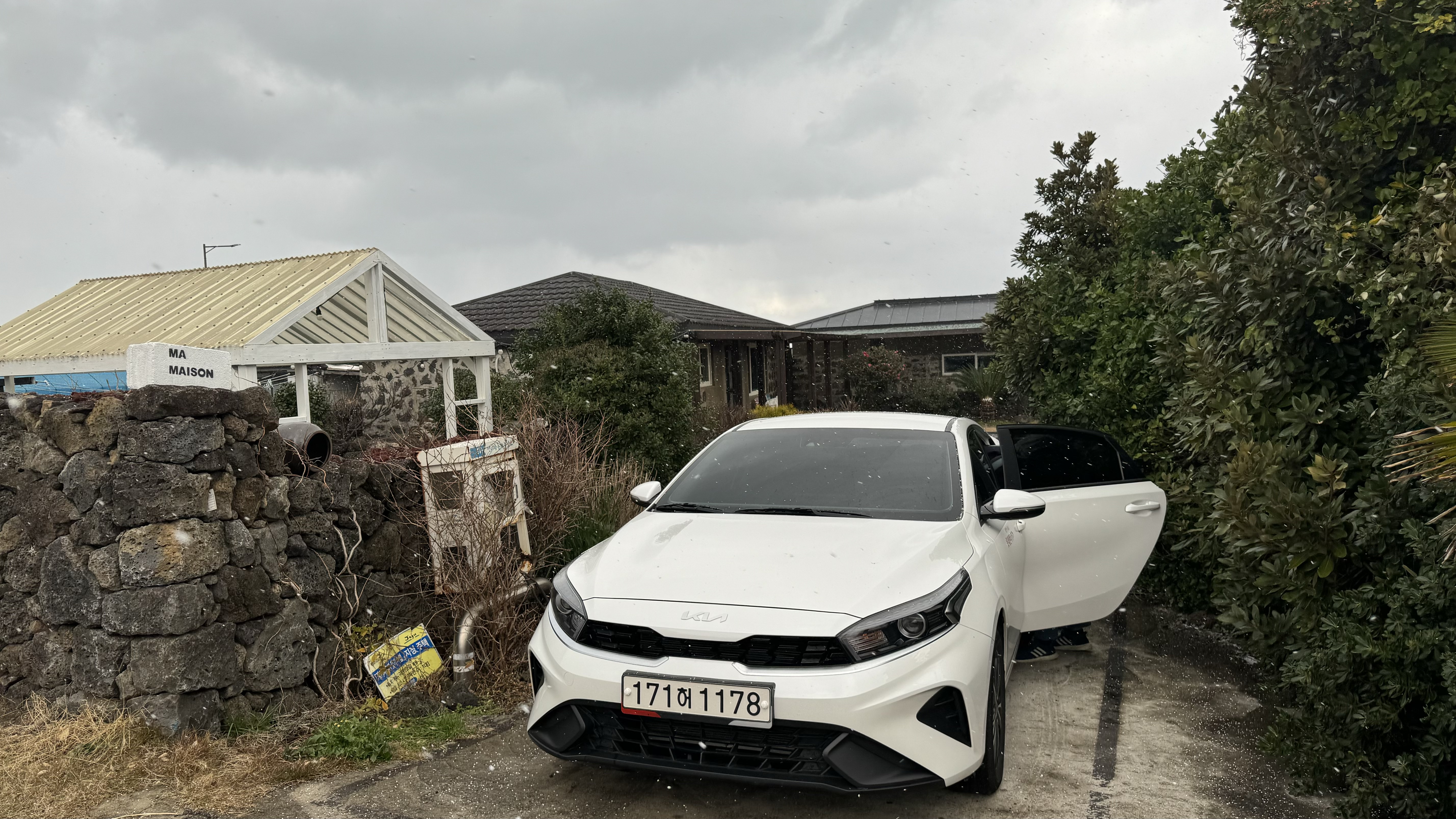
For starters, you would need to find a reliable car service in Jeju before you even take your flight to the island.
There is many car rental options in Jeju. After careful evaluation, we picked LOTTE Rent-a-car’s service at Jeju Auto House.
I definitely recommend LOTTE car rental at their Jeju Auto House. This is not just for their affordable car rental rates, but also the extra perks and services provided. You can read more about the special rates and discounts offered, as well as the pickup process here.
While we had a great experience driving in Jeju with LOTTE, I can’t guarantee the rest will provide a similar experience. It is good to find out in advance:
- If the car inspection is straightforward – do they pick out small flaws and charge you extra fees upon returning the car?
- If they provide 24 hours accident and maintenance if the car breaks down
- If GPS is provided for free (or you have to use your own mobile phone data)
- If snow chains are provided in winter – otherwise you have to pay extra to ensure your tires are safe for driving on the roads
Get your International Driver’s Permit (IDP)
You’ll NOT be able to drive in Jeju without the IDP, so this is extra important to remember!
In Singapore, you can either apply for the IDP online or walk in to one of the AA outlets. Walk-ins will allow you to get your IDP on the spot for just SGD20 and get it on the spot when you walk-in to apply for it.
Note: the IDP is recognised by the list of countries found in the booklet and valid within 1-year from the date of issue. You do not need to apply for multiple copies for the different countries you intend to visit.
Getting used to left-hand drive in Jeju

One of the most important things you’ll need to take note of is that Jeju uses left-hand drive. This is the opposite of countries like Singapore and Malaysia which practise right-hand drive.
The good news is that switching over is not as difficult as it sounds. You can practise getting used to it by slowly driving the car (which is highly encouraged anyway – more on that later).
At an intersection, the driver needs to check on the left side, and then the right side. If you have passengers in the car, you can also get them to remind you!
Make sure your car’s GPS is in English or a language you’re comfortable with
When you’re checking your car before driving off, make sure to also check if your car’s auto-fitted GPS is set to English or Korean.
There are a good number of Koreans from other cities who also rent cars to drive around Jeju, so English is not always the default language set on the GPS.
If you’re unsure how to set the language to English or another language you prefer, check with the staff at the rental company before you drive off!
Use phone numbers, not addresses, to find your destination on GPS
It sounds a little counterintuitive that you don’t input addresses in the GPS to navigate, but this is true!
In Singapore, you can simply type postal codes into the GPS and it’ll bring you to a specific building. However, postal codes do not work the same in Korea. From what I understand, they’re not unique to each building and even the building name itself is not searchable on GPS!
If you don’t have the telephone number of, say, the café that you want to drive to, you still can try typing in the name of the café and see if it works out. This has worked for us when we were trying to find our way to famous eateries such as Seogwipean Bakery.
Otherwise, your best bet is to use your phone’s GPS, which brings us to our next point…
Use Naver Maps as a navigation backup – but Google may work too!
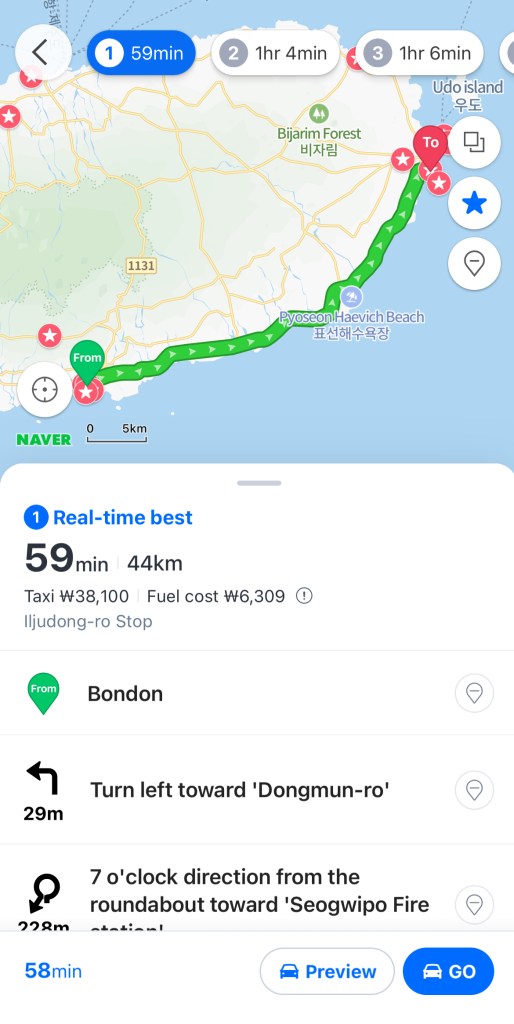
You can’t run away from installing Naver Maps on your phone if you’re travelling in Korea, and you’ll find that this comes in super handy when you have issues finding places on your car’s GPS.
A lot of travel websites have explicitly said that Google Maps does not work in Korea. While this is true to a certain extent, I have discovered in recent years that Google Maps is not totally unusable. There are some places that can be much easily located on Google – caveat being that these are popular and highly-searched attractions.
That being said, Naver Maps still trumps if you need reliable navigation in Jeju. It is also much better for finding local haunts and highly-recommended food places. Just don’t totally rule out using Google Maps if you’re desperate and don’t know how to use Naver!
Enjoy the simple road system & nice drivers in Jeju

For those who worry that Jeju’s roads are as complex and jammed as Seoul’s highways, fret not!
Jeju’s road system is fairly straightforward ,with only a few main roads connected all around Jeju. Road signs are generally in English and Korean, and all landmarks are signposted.
Roads are relatively flat and are rarely ever jammed. The ones further from the city (nearer the nature attractions or seaside villages) tend to be narrower and curve a lot, but the bends do keep you alert so you don’t doze off while driving on long stretches.
We drove in winter where it turned dark VERY early because the sun sets at around 4-5pm, but didn’t find much of a problem because all the roads were very well-lit.
Our main worry was the snow and frost that hit the roads, especially on days with snow flurries. Luckily the roads in Jeju are very well-maintained and our car’s tyres have a good grip. Hence, we didn’t have issues driving and didn’t need snow chains either!

I generally find that drivers in Jeju are much more patient than those in Seoul – they do honk sometimes if you’re making mistakes, but this is more of a friendly warning rather than angry raging.
Watch out for speed limits & speed cameras all over Jeju
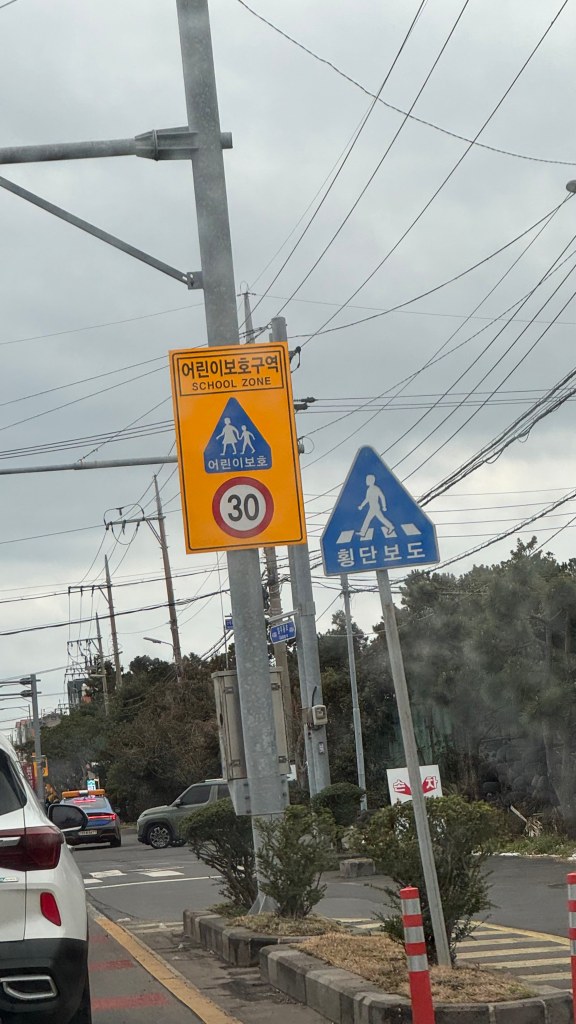
Generally, the speed limit is 70 – 80km/h on most of the roads in Jeju. I have never seen any that allow beyond 80km/h when we were driving in Jeju, so most people do drive at a pretty relaxed pace!
However, do note that speed limits slow to 50km/h at elderly/silver zones. These are further reduced to 30 km/h in school zones!
The Jeju authorities take speeding pretty seriously. Many speed cameras are installed islandwide, even in the far-flung seaside villages. Your rented car’s GPS will also prompt you with loud warnings once you drive over the stipulated speed limit.
We sometimes did observe certain local drivers going over the speed limit by a little – but best to be safe!
Enjoy free/cheap & plentiful parking in Jeju
Unlike Singapore where we struggle to find parking and pay exorbitant fees, parking in Jeju is such a breeze.
Parking in Jeju is usually free at restaurants, hotels, and town areas. Our Jeju Airbnb also provided free parking. You may have to check with your accommodation if it comes with a parking lot. Otherwise most places allow you to park pretty freely, especially if you’re not staying in the city.
Most tourist attractions will have their own parking spaces – the staff on hand will guide you, otherwise you can just follow the other cars. Some famous attractions may charge for parking (think Jeongbang Waterfalls charged us), ranging from KRW1,000 to 3,000.
The local markets like Dongmun Market and Seogwipo Maeil Olle Market usually have multi-storey car parks located nearby. Unlike Singapore which typically use automated parking systems, the ones in Jeju are manned.
We made payment using cash, but I’m not sure if they would take credit cards and T-money – it wasn’t an option offered to us!
Pumping petrol at petrol kiosks may not be cheap (prices also differ!)
You’ll definitely have to pump petrol at some point in time when driving in Jeju. Driving around the island can really burn through your fuel pretty fast, especially if you’re driving for hours daily. You’ll also need to fill to full tank before you return your car to the car rental.
It’s not easy to check petrol rates at individual petrol stations online, so we just found the most convenient petrol kiosk to refuel. The attendants will help to fill up so you don’t have to worry too much. Credit cards and cash were accepted.
Some travel guides and bloggers have suggested that petrol prices can fluctuate greatly across the island. Pumping petrol in Seogwipo seems to be cheaper than in Jeju City.
I can’t remember how much we pumped that time, but a quick search online shows that Jeju’s petrol prices are on par with those in Singapore. That is honestly not cheap, but if you’re just pumping petrol 1 or 2 times it won’t hurt your wallet too badly. Just remember to set aside a budget for it!
Related Posts:
- Road 1100 – The best winter views in Jeju!
- Jeju Dongmun Traditional Market: oldest traditional market in Jeju!
- Iho Tewoo Beach: Jeju beach with famous horse lighthouses
PIN THIS!
FAQ: Driving in Jeju (Safety Rules & Tips)
Important safety rules and practical tips before you hit the road in Jeju.
South Korea drives on the right-hand side of the road. If you’re from Singapore, Australia, or the UK, this is the biggest adjustment. Take it slow for the first 15–20 minutes until your brain recalibrates.
Yes — and they are strictly enforced. Speed cameras are extremely common in Jeju, especially near intersections, tunnels, and school zones. Fines are automatically issued to the rental company and passed on to you.
Typical limits:
- 30 km/h in school zones
- 50–60 km/h in city areas
- 70–80 km/h on larger roads
When in doubt, follow the posted signs carefully.
Yes, a few important ones:
- Zero tolerance for drink driving. Penalties are severe.
- Seatbelts are mandatory for all passengers.
- Child car seats are required for young children.
- No phone usage while driving unless hands-free.
Police checks are not uncommon, especially during peak tourist seasons.
Night driving is generally safe, but rural coastal roads can be dimly lit. If it’s your first time driving on the right side, try to schedule longer drives during daylight hours until you feel confident.
Main roads are wide and well maintained. However, if you drive around coastal cliffs or near Hallasan mountain, expect winding roads and occasional fog in rainy weather.
Drive slower in bad weather conditions and use headlights appropriately.
If there is an accident:
- Stay calm and move the vehicle to a safe location if possible.
- Call the rental company immediately.
- Dial 112 for police or 119 for emergency services.
Take photos and do not leave the scene until instructed.
Yes — most tourist attractions have dedicated parking lots. Parking is generally safe and affordable compared to major cities. Just avoid blocking narrow residential lanes.



Leave a Reply