
If you’re not travelling with a tour group and are wondering how you can get around Korea without always calling a cab, the answer is T-money.
T-money is a rechargeable smart card used for convenient travel around South Korea. It is prevalently used in major cities like Seoul, Busan, and Incheon for public transportation and at various retail locations.
Having a T-money card makes navigating Korea’s transportation systems smoother. There’s also the added benefit for using it as a cashcard in the worst case scenario that you run out of cash or your credit card is rejected!
Here’s a guide to everything you need to know about buying and using T-money in South Korea.
What is T-money?
T-money is a prepaid transportation card used across South Korea’s public transport systems, including buses, subways, taxis, and even some national trains.
In addition to transportation, T-money can be used at convenience stores and various vending machines. It’s one of the most efficient ways to pay for transit, eliminating the need to carry cash for every ride.
Where to buy a T-money card
- Convenience Stores: The easiest way to purchase a T-money card is at convenience stores such as GS25, 7-Eleven, or CU. Most stores will have T-money cards for sale near the cashier.
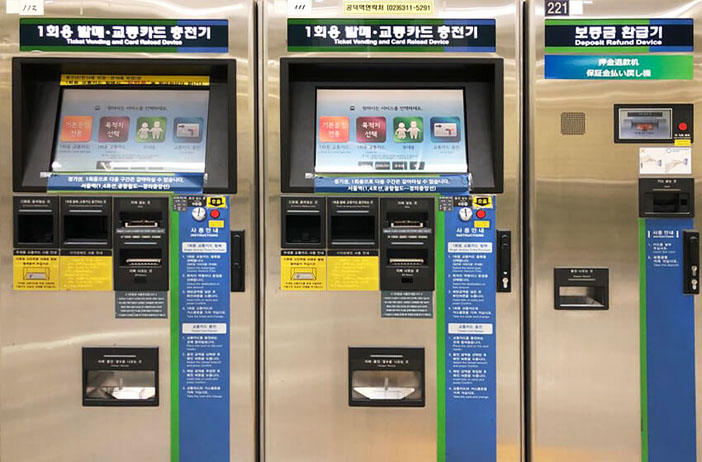
- Subway Stations: You can also buy T-money cards at ticket vending machines located inside subway stations. Look for machines labeled with “T-money” or visit the customer service booth at most major stations.
- Incheon International Airport: If you’re arriving in South Korea via Incheon Airport, you can buy a T-money card directly at one of the convenience stores or kiosks in the arrival area.
- T-money Mpass: If you’re planning to stay in South Korea for a short period, consider purchasing a T-money Mpass, a special version of T-money designed for tourists. This card allows unlimited rides on buses and subways within a certain time frame.
How to use T-money on public transport
Subway
- Tap in: Simply tap your T-money card on the card reader when entering the subway station. You’ll hear a beep, and the turnstile will open.
- Tap out: Tap the card again when exiting the station. The fare is automatically calculated based on the distance traveled.
Buses
- Tap when boarding: Place the card on the card reader when you get on the bus. The fare will be deducted instantly.
- Tap when exiting: If you’re transferring to another bus or subway, make sure to tap the card again before you get off to ensure the correct fare and transfer discounts.
Taxis
- Some taxis in South Korea also accept T-money as a form of payment.
- Look for a T-money logo on the taxi, and simply tap the card on the reader at the end of your trip.
How to recharge your T-money card
Recharging a T-money card is very easy and can be done at any of these locations:
- Convenience Stores: Visit any GS25, CU, or 7-Eleven, and ask the cashier to recharge your card. You can add any amount of money starting from 1,000 KRW.
- Subway Stations: Recharge the card at ticket vending machines located in subway stations. Most machines have an English-language option for tourists.
- Mobile Apps: Some apps allow for recharging T-money cards. However, note thta this is generally more applicable to locals, as it may require a Korean bank account or credit card.
T-money card discounts
- Transfer Discounts: One of the biggest benefits of using a T-money card is the automatic application of transfer discounts. If you transfer from a subway to a bus, or vice versa, within 30 minutes, your fare will be significantly reduced.
- Age-Based Discounts: Special discounted T-money cards are available for children and teenagers. These cards apply lower fares automatically when tapped on transportation card readers.
Additional uses for T-money
Beyond public transportation, T-money can be used at:
- Convenience Stores: Most stores, including GS25, CU, and 7-Eleven, accept T-money as payment for snacks, drinks, and other goods.
- Vending Machines: You can also use the card at vending machines in subway stations and public places across the country.
- Cafés and Restaurants: Some smaller shops and cafés in tourist-heavy areas accept T-money as well.
Where to check your T-money card balance
You can check your balance by tapping the card on a card reader at any subway turnstile, bus reader, or taxi. The remaining balance will be displayed on the screen.
Additionally, ticket machines in subway stations allow you to check and recharge your card at the same time.
Try the Korea T-Money Card Budget Estimator!
What if I lose my T-money card?
If you lose your T-money card, unfortunately, the balance on the card is non-refundable unless you have registered it (which is rare for tourists).
Make sure to keep the card in a secure spot and not load too much money at once to minimise your loss in case of misplacement!
Related Posts:
- HOW TO: ship parcels back home by Korea Post
- BUY & TRY: Korea Street Food Guide
- How To: buy KTX train tickets in Korea (complete guide!)
- What Does It Mean to See Money in Your Dreams?
PIN THIS!
FAQ: Tmoney Korea Guide
Answers to common questions about using the T-money card for travel in South Korea.
A T-money card is a rechargeable transportation smart card used throughout South Korea to pay for public transport like subways, city buses, and even some taxis with a simple tap when boarding or entering/exiting. It’s widely accepted and very convenient for travel around cities and beyond. :contentReference[oaicite:0]{index=0}
You can buy a T-money card as soon as you arrive in Korea, including at Incheon Airport (convenience store counters or vending machines), most subway/train stations, and many convenience stores (like CU, GS25, 7-Eleven). It’s simple — just buy the card, then top up before use. :contentReference[oaicite:1]{index=1}
You can top up at subway stations using ticket machines, at convenience stores by telling the cashier how much you want to add, or at dedicated T-money counters. Most machines accept cash (Korean won), and topping up is quick and easy wherever you are. :contentReference[oaicite:2]{index=2}
Yes — for buses and subway systems, you usually tap your T-money card both when you start and finish your journey. This ensures you pay the correct fare and receive any applicable transfer discounts. :contentReference[oaicite:3]{index=3}
T-money works in many Korean cities — including Seoul, Busan, Daegu, and more — on public transport buses and subway systems. Some taxis also accept it, and many convenience stores let you pay small purchases with your card. :contentReference[oaicite:4]{index=4}
Yes — tourists can easily buy and use a T-money card with no Korean ID or passport registration required. It’s designed for both local transport use and easy traveller access. :contentReference[oaicite:5]{index=5}
Yes — while its main use is for transport, T-money is accepted at many convenience stores, vending machines, and some retail outlets across Korea as a contactless payment method. Just look for the T-money logo at the register. :contentReference[oaicite:6]{index=6}
No — the standard T-money card itself doesn’t expire, so you can keep it and reuse it on future trips if you recharge it again. :contentReference[oaicite:7]{index=7}
Yes — you can refund unused T-money balance at convenience stores or T-money service counters in subway stations. Keep your card and ask staff about refunds before you leave Korea. :contentReference[oaicite:8]{index=8}


Leave a Reply